Why Use an Insulated Raft Instead of a Traditional Raft with Insulation Above?
Insulation below the slab does more work, with less effort. When insulation sits above a concrete raft, the concrete sits outside the building's thermal envelope and becomes a thermal bridge. With insulation below — as in an insulated raft system — the concrete is brought inside the thermal envelope, the thermal bridge at the slab edge is eliminated, and the concrete's thermal mass works for you rather than against you.
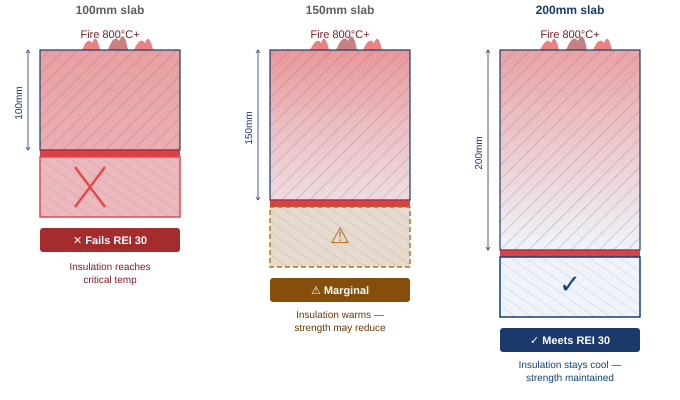
Four things that change when the insulation moves below the slab
1. The insulated raft system is its own shuttering
A traditional raft needs temporary formwork to be erected before the concrete can be poured, then struck and removed afterwards. The insulated raft system — the shaped EPS modules that form the base and edge of the slab — is the formwork. It goes down, the steel goes in, the concrete goes in, and it stays. No separate shuttering to hire, erect, or strip.
2. No additional blockwork to reach finished floor level
A traditional raft with insulation above still needs one or two courses of blockwork at the perimeter to bring the wall up to the level where the damp proof membrane goes. With an insulated raft, the walls sit directly on a flat, level concrete surface at finished floor level. The sole plate goes straight onto the slab.
3. No screed
Insulation above the slab needs a screed on top — to protect the insulation, provide a level surface, and bed any underfloor heating. An insulated raft, power-floated to a good finish, is ready for floor finishes directly. If underfloor heating is being used, the pipework is cast into the slab itself.
4. The walls are shorter
Insulation and screed above the slab adds thickness between the structural slab and the finished floor. That thickness has to go somewhere: either the walls get taller to compensate, or the ceiling height reduces. With an insulated raft, the finished floor level is as low as it can reasonably be.
An insulated raft system is the shuttering, the foundation, the floor slab, and the insulation layer — all in one. A traditional raft with insulation above is four separate elements, each with its own materials, trades, and programme.
The thermal performance of a well-designed insulated raft typically achieves U-values of 0.10 W/m²K or lower — comfortably below the threshold required for buildings targeting low-energy or Passivhaus performance standards.
Read the full answer
Enter your details below once to unlock the complete article and all gated Knowledge Centre content.
One registration unlocks all gated content — no repeat forms.