Insulated Raft Foundations Explained

Not all insulated raft foundations are equal. Here's what to look for — and the costly mistakes to avoid.

← Back to Knowledge Centre

If you're specifying or building a low-energy home, you've probably come across the term "insulated raft foundation." But not every system that carries the label delivers the same performance. Understanding the difference can save you from thermal bridging, costly remedial work, and a foundation that underperforms for decades.

An insulated raft foundation is a ground-bearing slab where the insulation is integrated into the foundation structure itself, rather than sitting above or below a conventional concrete slab. The principle is simple: by wrapping the building's thermal envelope down to ground level, you eliminate the cold bridge that typically occurs where the floor meets the foundations.
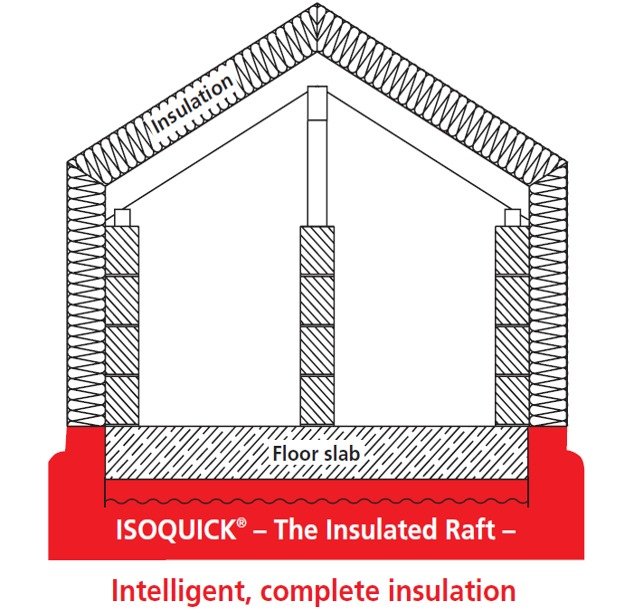
House section showing ISOQUICK continuous insulation beneath the floor slab and around the building envelope
ISOQUICK® forms a continuous insulated foundation beneath the floor slab and external walls.

Continue reading

Unlock the full article and all gated content across the ISOQUICK® Knowledge Centre.

One registration unlocks all content — no repeat forms.

What Makes an Insulated Raft Different?

Traditional construction often places insulation above the structural slab, with screed and finishes on top. This creates a thermal bridge at the slab edge, where the concrete is exposed to the outside air. An insulated raft solves this by placing the structural concrete within the insulation layer, so the entire foundation perimeter is thermally protected.

The key performance indicators for any insulated raft are:

U-value — This measures the thermal transmittance of the floor element. A lower U-value means less heat loss. For Passivhaus compliance, ground floor U-values typically need to be below 0.15 W/m²K, and often significantly lower depending on the building geometry.

Psi-value (linear thermal transmittance) — This is where many specifications fall down. The Psi-value measures heat loss at the junction between the floor and the wall, or at any other linear bridge. A foundation can have an excellent U-value but a terrible Psi-value at the edge, meaning the overall building envelope still leaks heat.

The U Value vs Psi Value Trap

We've seen specifications where the insulated raft achieves a U-value of 0.10 W/m²K — impressive on paper — but the Psi-value at the wall-floor junction is 0.30 W/mK or higher. In a compact building, that junction heat loss can account for a significant proportion of total fabric loss.

The trap is specifying on U-value alone. Building Regulations Part L now recognises this, requiring designers to account for junction losses through SAP and PHPP calculations. But some suppliers still quote impressive U-values without addressing the edge detail, leaving the designer to discover the problem during compliance modelling.

The honest answer is that both numbers matter, and they must be considered together. A well-designed insulated raft should deliver both a low U-value and a low Psi-value at every typical junction.

How to Get It Right

After 16+ years of designing and delivering insulated raft foundations across the UK, we've learned that getting it right comes down to three things:

1. Design the foundation as part of the thermal envelope. The foundation isn't a separate element — it's where the thermal envelope meets the ground. The insulation strategy, airtightness layer, and damp-proofing must all be considered as one system.

2. Use certified, tested details. Don't rely on generic details or optimistic modelling. Insist on Psi-values that have been independently calculated or measured for your specific wall-floor combination.

3. Plan for buildability. The best thermal detail is worthless if it can't be built correctly on site. Pre-engineered systems with clear installation guidance reduce the risk of thermal bridges being introduced during construction.

Certification Matters

Look for components that carry independent certification. ISOQUICK is a Passivhaus Certified Component and holds KIWA BDA Agrément certification, meaning the thermal performance has been independently verified and the details have been assessed for buildability and durability.

If you're comparing insulated raft foundations, ask every supplier for both the U-value and the Psi-value for your specific wall type. If they can only provide one, you're not getting the full picture.

Browse technical downloads →

Who is this for?

Self-Builders Architects Timber Frame Companies Builders & Developers